

Prioritise health in your next renovation project and achieve
an allergen-aware home
The hidden culprits most renovators overlook
There’s a particular kind of pride that comes with finishing a renovation. The fresh paint. The way light hits a new surface. The sense that you’ve invested in something that will last. What most of us don’t consider, but probably should, is that the decisions made during those months of planning and building have a direct impact on something far more important than aesthetics: the quality of the air your family breathes every single day.
It’s a confronting statistic, but indoor air quality can be up to five times worse than outdoor air. We seal our homes, insulate them, draught-proof them. In doing so, we might inadvertently trap allergens, chemicals and moisture with nowhere to go. The result? A home that looks impeccable but might be quietly working against you.
For the one in nine Australians living with asthma and one in five with allergies, this is more than a minor inconvenience. It’s a daily health reality. But even for households without those specific sensitivities, the case for renovating with air quality in mind is compelling. A home that supports your health isn’t a compromise. With the right execution, it’s the ultimate upgrade.
The hidden culprits most renovators overlook
The obvious renovation hazards, including asbestos, lead paint and silica dust, are well understood. It’s the invisible, ongoing ones that catch people off guard. Many conventional building products contain volatile organic compounds (VOCs), including formaldehyde, phthalates and synthetic fragrances, that continue emitting particles into your air long after the tradies have packed up. That new-home smell people sometimes celebrate? In many cases, it’s off-gassing.
Beyond building materials, some of the most common allergen sources in the home are things we’d never think to question. Old carpet accumulates years of dust mites and pet dander in a way that feels impossible to fully clean. Blind and curtain fabrics, particularly in bedrooms, trap allergens where we spend eight hours a night breathing. A bathroom without adequate ventilation creates the persistent moisture that mould needs to thrive behind your beautiful new tiles.
The challenge is that most of these triggers are invisible. You can’t see a dust mite or detect formaldehyde at low concentrations. But if you or someone you love has asthma or allergies, your body very much notices them, often in ways that get written off as seasonal, stress-related or just “how things are”. Experiencing any difficulty breathing (coughing, wheezing, chest tightness) can potentially be symptoms of asthma flaring up, even if it feels “mild” it should be taken seriously. Asthma can be triggered by allergens like VOCs or mould or dust mites.
Where to focus your attention, room by room
A healthier home renovation doesn’t require ripping everything out and starting again. It’s about making considered choices at key decision points: the moments when you’re already choosing between options, and one of those options simply works harder for your health.
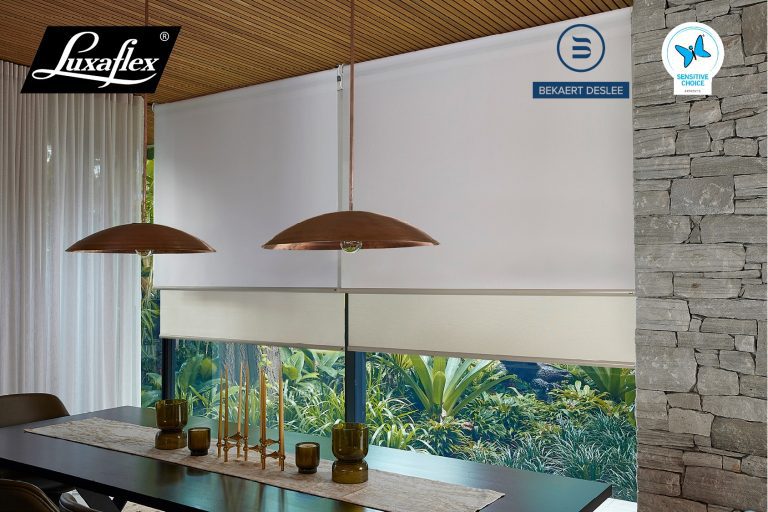
The bedroom is where most of us should start. We spend roughly a third of our lives in this room, which means it can have a significant impact on our health. Window can be the most overlooked source of allergens in the bedroom. Fabric that traps dust traps dust mites, full stop. Replacing curtains with Luxaflex® roller blinds made from Bekaert Deslee’s Sensitive Choice® approved fabrics, including the Haven and Sorelle blockout collections, is one of the more elegant solutions available. Both are anti-dust mite, anti-bacterial and anti-fungal, with anti-static technology that minimises dust attraction in the first place. They’re also genuinely beautiful: locally developed, thoughtfully designed, and made to last.
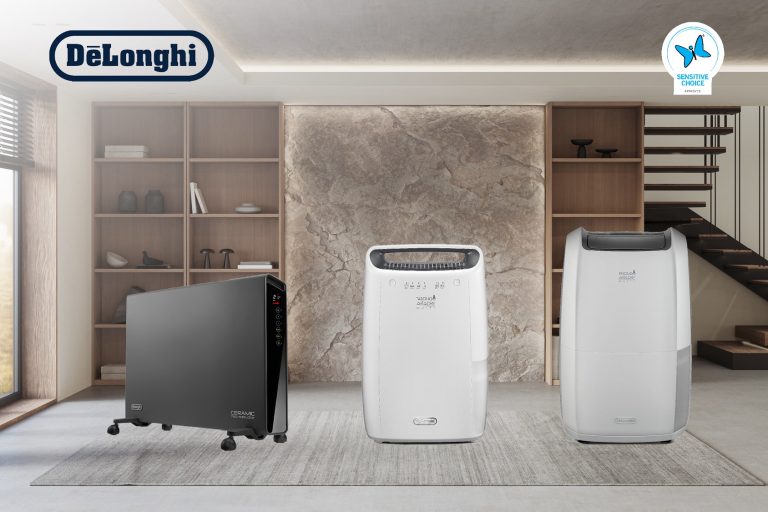
The bathroom and laundry are the humidity hotspots. Without proper ventilation or active dehumidification, moisture lingers and mould follows, sometimes visibly but always persistently. De’Longhi’s Sensitive Choice® approved dehumidifiers work in two ways: eliminating excess moisture from the air while simultaneously filtering it through a four-stage system that captures pollen, dust, bacteria and pet dander. It’s the kind of quiet, unglamorous work that makes a genuinely significant difference to how a home feels to live in.
Heating is another category worth reconsidering. Gas heaters can introduce combustion byproducts into your indoor air, something that rarely comes up in showroom conversations but matters considerably for those with respiratory sensitivities. De’Longhi’s panel and convector heaters offer a Sensitive Choice® approved alternative: efficient, silent, electric warmth that integrates cleanly into any interior without any air quality trade-off.
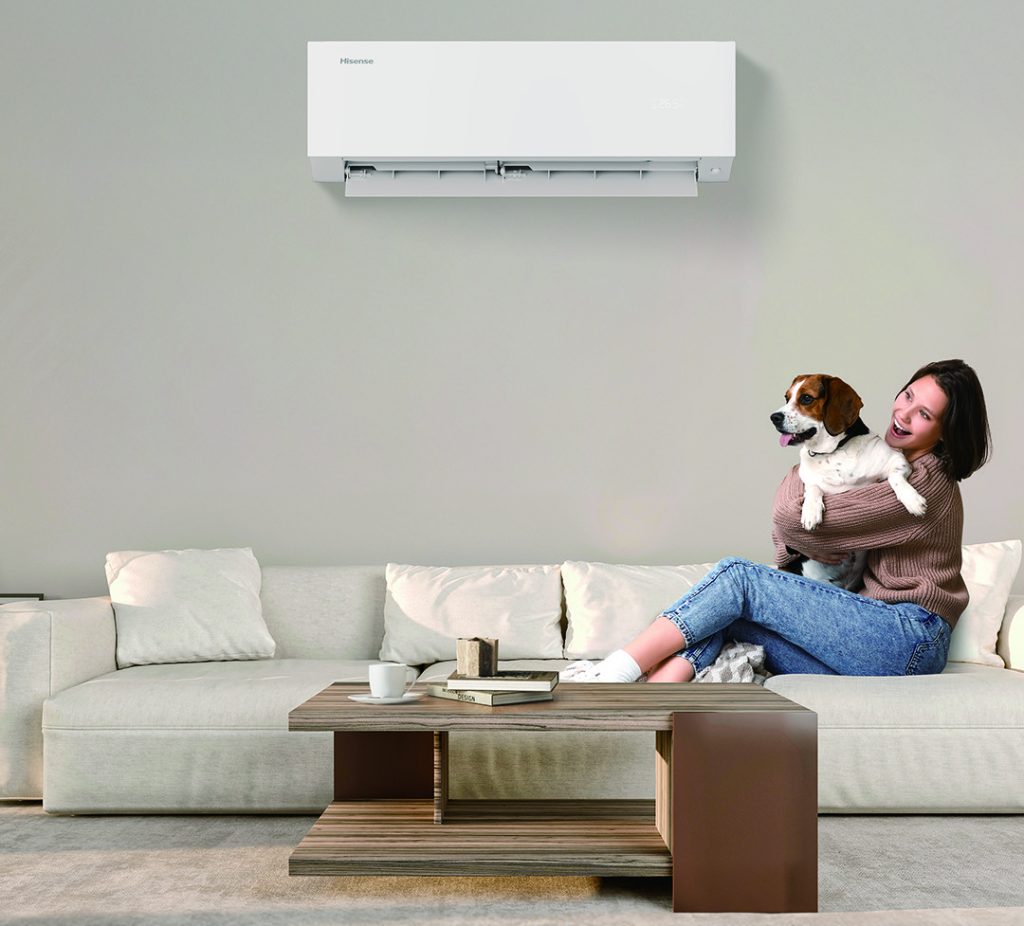
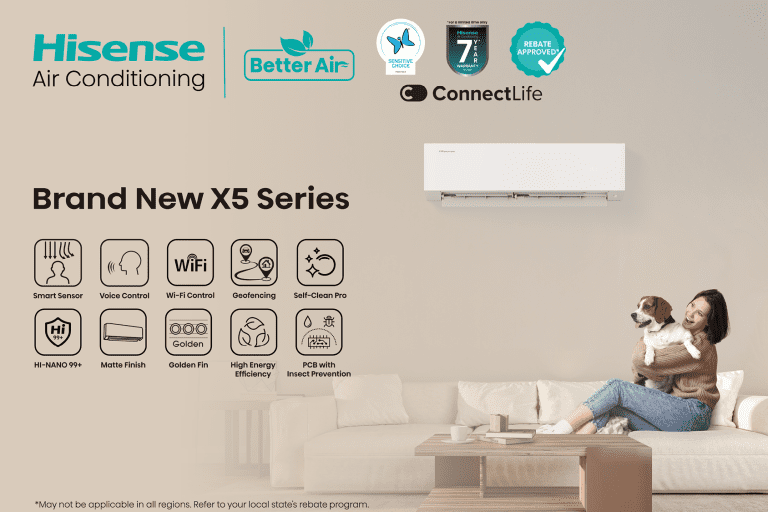
Living areas benefit most from a considered approach to air conditioning and purification. Modern Hisense air conditioning and systems, which are also Sensitive Choice® approved, go beyond temperature control, actively filtering allergens throughout your living spaces. Hisense’s HI-NANO is an advanced and highly efficient plasma ion air purification technology designed to improve indoor air quality at a microscopic level. If you’re planning an HVAC upgrade as part of your renovation anyway, choosing a system that improves your air quality rather than simply circulating it is a decision you’ll feel the benefit of immediately.
All rooms in your home can be improved with an air purifier to remove allergens that compromise your air quality. Coway’s Airmega air purifiers are globally recognised for their effectiveness in reducing airborne allergens and pollutants. Coway Airmega air purifiers feature multi-stage filtration systems that captures up to 99.97% of airborne particles, including dust mites, pollen, smoke, and pet dander. Its deodorisation and HEPA filters work together to eliminate odours and harmful gases, while the pre-filter captures larger airborne particles like dust and pet hair. From compact solutions like the Airmega 50 and 100 to large-space purifiers including the Airmega 350 and 400, there’s a Coway purifier for every room and lifestyle.
The one symbol worth knowing
Navigating “allergy-aware” product claims can be exhausting, and a lot of it is marketing. The Sensitive Choice® program, run by the National Asthma Council Australia, exists specifically to cut through that noise. Products carrying the Sensitive Choice® blue butterfly have been independently reviewed and approved by an expert panel. It’s the clearest signal available that a product has been genuinely evaluated for its potential to benefit people with asthma and allergies.
The program now covers an impressive and growing range of categories: window furnishings, dehumidifiers and heaters, air conditioning and purification systems, and more. When you see the trusted blue butterfly, you can be assured that the product has been independently assessed, with the leg work done for you..
The renovation checklist worth saving
Whether you’re undertaking a full renovation or making targeted upgrades room by room, these are the decisions that have the greatest impact on your home’s health.
Choose low-VOC or zero-VOC paints and finishes. Look for Sensitive Choice® approved blind and window fabrics rather than curtains that accumulate allergens. Install adequate bathroom exhaust ventilation, which is unglamorous but genuinely important. Consider a dehumidifier for laundry and bathroom areas, particularly in humid climates. Look at whether your HVAC system includes air purification, not just temperature control. Opt for electric panel where possible. Use formaldehyde-free cabinetry and MDF products. Check for existing mould before closing up walls. And ventilate rooms thoroughly after renovation before moving back in, as that off-gassing period matters. Choose air purifiers with a HEPA-13 filter (guaranteed to filter out 99.97% of air particles as tiny as 0.3 microns) so your home has fresh, clean air.
None of these choices require compromising on the home you’ve envisioned. In most cases they’re decisions between two options that look identical on the surface, where one simply works harder for the people living inside it. That, in the end, is what good renovation really means.
See Sensitive Choice® approved products including Coway, Luxaflex®, De’Longhi and Hisense in person at the Melbourne Home Show, 17-19 April at the Melbourne Convention and Exhibition Centre. Experts from each brand will be on hand to talk through your specific renovation plans and help you find the right solution for your home.